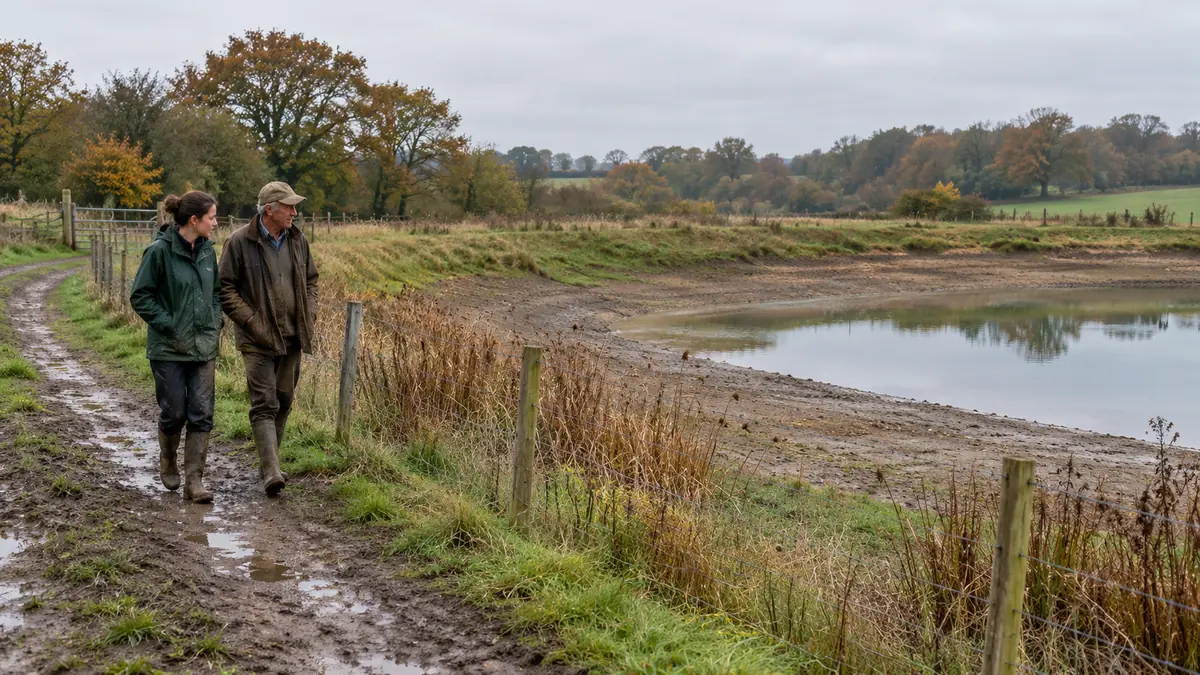
England’s reservoirs were 59.1% full on November 10, according to the Environment Agency’s latest national drought report. Storage was falling at most of the reservoirs and groups of reservoirs it tracks. Nine were classed as exceptionally low for the time of year. The agency monitors water supplies and the condition of rivers and groundwater.
In a separate November 17 update, the agency said measures including moving water to some of the lowest reservoirs had helped stabilize the situation. It also said England would need at least 120% of average rain over the next five months to come out of drought everywhere by spring. That means about a fifth more rain than usual over that period.
Daylight Post found that an average winter could refill many farm reservoirs and still leave parts of England in drought. We compared the latest national update with the agency’s earlier projections for farm reservoirs. The reports answer different questions. One tracks drought across England. The other asks how much water growers could have stored by the time they need it again.
Rain falling and water being stored are separate steps
Rain needs to soak through the soil before it can replenish water stored underground. The agency says dry soils are slowing that recovery. Groundwater levels were still falling at most monitoring sites in the latest report. River levels matter too, because some farmers rely on rivers to fill their own storage reservoirs.
The winter refill season began on November 1. Even during that season, farmers may have to take less water, or stop taking it, when rivers run too low. The agency reported 486 restrictions on licenses to take water, up from 336 the week before. That is 150 more restrictions. The figures are license restrictions, so they cannot be used to count affected farms.
Average rainfall would help much of England
The Environment Agency’s November 2 report considers what would happen if winter rainfall matched its long-term average. It projects good refill prospects for farm reservoirs across most of England. Prospects are weaker in the West Midlands, Devon, Cornwall and East Anglia, where slower recovery in rivers and groundwater could leave some reservoirs partly empty going into spring.
The estimates describe possible outcomes under different amounts of rain. The agency’s 120% figure is what it says is needed for drought recovery across England. It does not predict how much rain will fall or set a single threshold for lifting every local restriction.
What this means for water at home
The latest report lists ten main water companies with temporary restrictions on household water use in all or part of their supply areas. It also lists smaller suppliers with restrictions. These can limit activities such as watering a garden with a hose. Customers need to check the company serving their address for the rules in force there.
Households have been asked to use less while water suppliers have their own work to do. The agency says company bosses were told at the November 12 National Drought Group meeting to fix leaks faster. The agency’s annual report found that just under 19% of the water put into supply was lost through leaks in the 2025 to 2026 reporting year. That is a share of water across the system, separate from how full the reservoirs are.
Recovery will show up in the water that reaches rivers, underground stores and reservoirs. That is what matters to a household waiting for restrictions to end or a grower planning what to plant in spring.